How Small Brands Can Start Importing
Starting a home decor brand does not always require a large inventory investment. For startups, boutique retailers, interior designers, and online stores, finding a low MOQ home decor supplier can make it possible to test products, validate customer demand, and build a collection without committing to thousands of units.
China remains an important sourcing market for home decor, including woven baskets, rattan products, textiles, ceramics, lighting, wall decor, and decorative accessories. However, traditional manufacturers often require 500–1,000 pieces per SKU or color, which can be difficult for small brands.
In this guide, we cover what small businesses need to know:
- What low MOQ means for home decor sourcing
- Which home decor products are easier to source in small quantities
- How to find low MOQ suppliers in China
- ODM vs. OEM for small brands
- How to negotiate MOQ requirements
- Sample orders and product testing
- Pricing and landed cost considerations
- Quality control and compliance
- Private label and packaging options
- How to build a small but scalable first order
What Is a Low MOQ Home Decor Supplier?
MOQ stands for Minimum Order Quantity. It is the minimum number of units a supplier requires a buyer to order for a specific product, design, color, or SKU.
For example, a traditional home decor manufacturer may require:
- 500 pcs per design
- 500 pcs per color
- 1,000 pcs per SKU
- 3,000 pcs for a custom product
A low MOQ supplier may instead accept:
- 50–100 pcs for selected products
- 100–300 pcs for ODM products
- Mixed colors or designs within one order
- Small trial orders before larger production
- Lower quantities for standard products
However, low MOQ does not have one universal definition. A 300-piece MOQ may be considered low for one category but high for another.
For a small home decor brand, the most useful question is not simply “What is your MOQ?” Instead, ask:
“What is the minimum quantity I can order while keeping the product commercially viable?”
This approach helps you evaluate MOQ together with unit price, customization, packaging, shipping, and production lead time.
Home Decor Products Suitable for Low MOQ Orders
Some product categories are naturally easier to source in small quantities than others.
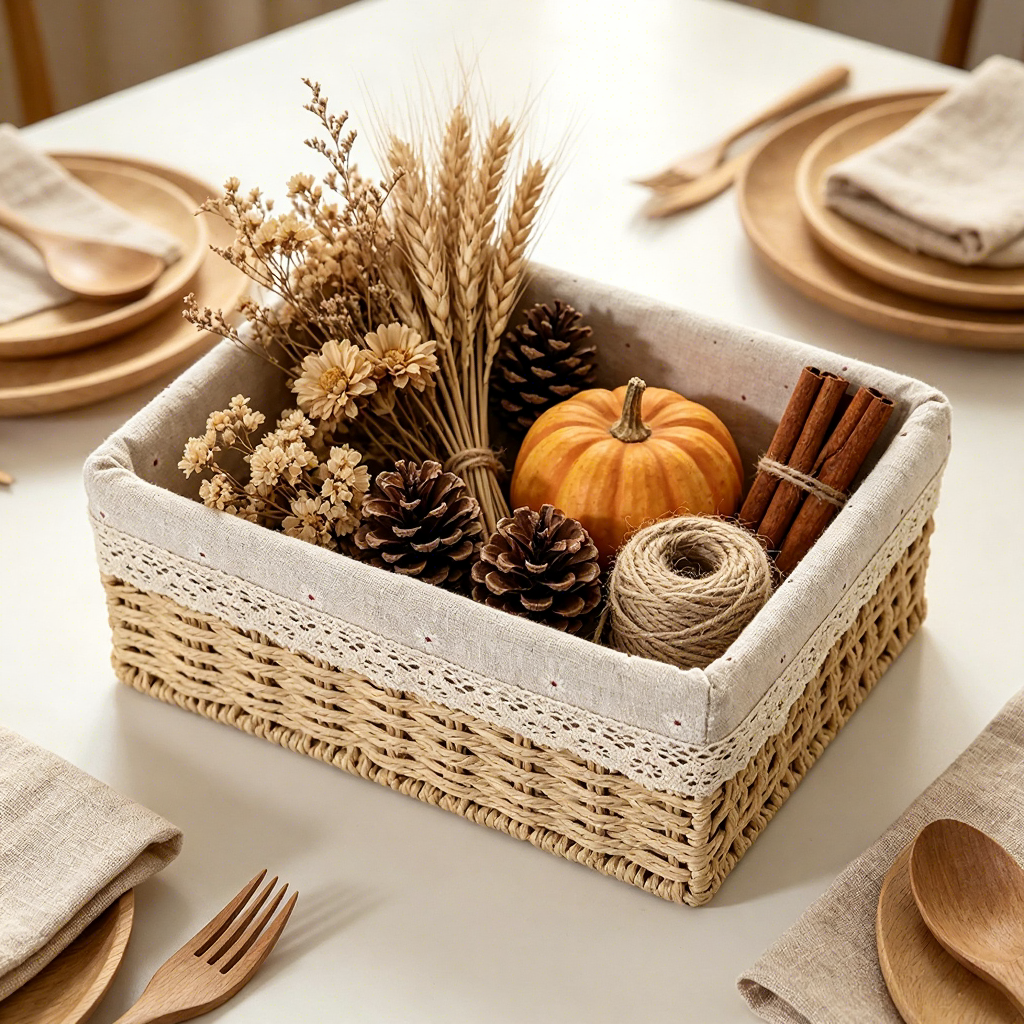
1. Woven Baskets
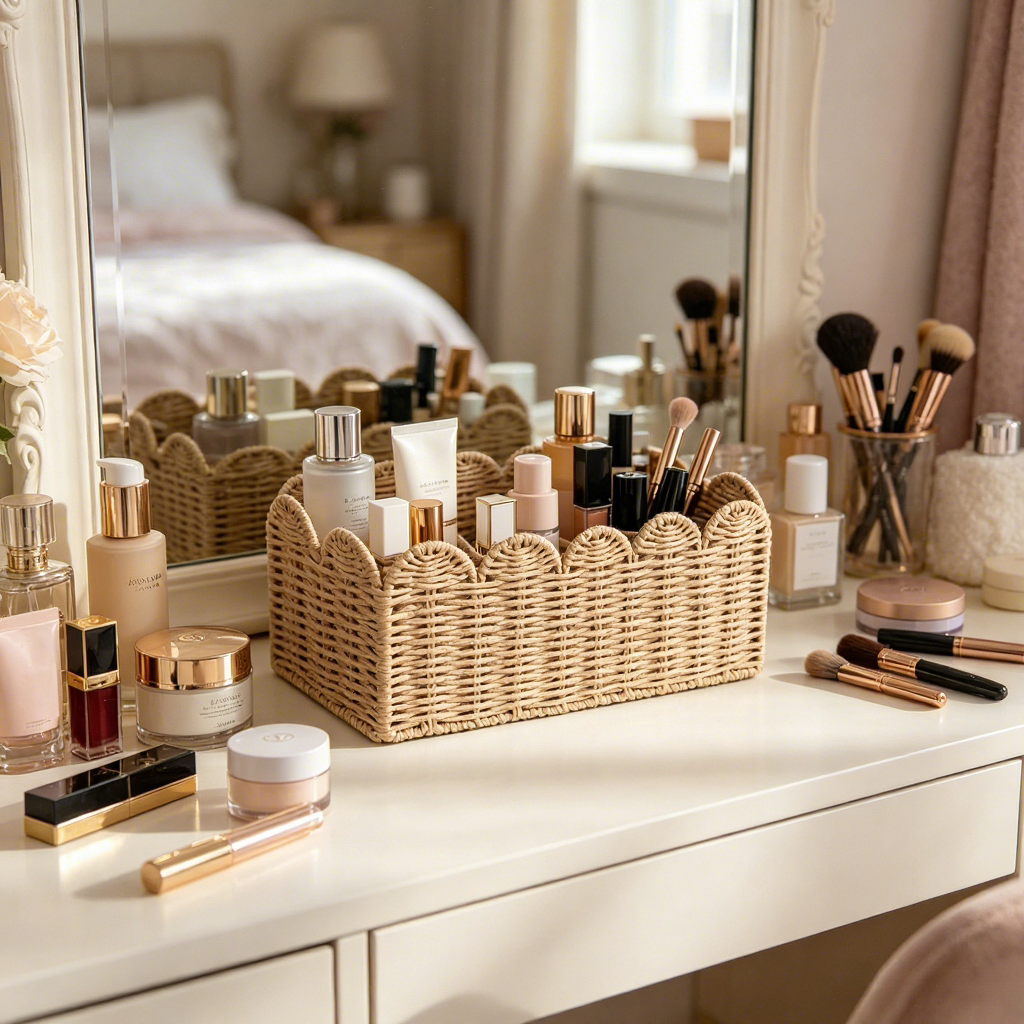
Woven baskets made from rattan, seagrass, water hyacinth, paper rope, bamboo, and other natural materials can be suitable for small-brand sourcing.
Examples include:
- Storage baskets
- Laundry baskets
- Planter baskets
- Belly baskets
- Seagrass baskets
- Water hyacinth baskets
- Decorative baskets
- Storage boxes
- Tray sets
Many woven products are based on existing factory designs, which means a buyer may not need to pay for extensive tooling or product development.
2. Decorative Accessories
Standard decorative products can also be easier to source with a lower MOQ:
- Trays
- Bowls
- Vases
- Decorative boxes
- Wall decor
- Mirrors
- Tabletop accessories
- Artificial flowers and plants
The key is to select an existing product rather than requesting a completely new design.
3. Textiles
Small brands can potentially source:
- Cushion covers
- Throw pillows
- Table runners
- Fabric baskets
- Curtains
- Decorative textiles
However, fabric color, printing, embroidery, and custom materials can increase the minimum order quantity.
4. Lighting and Woven Lamps
Rattan, seagrass, bamboo, and other woven lighting products can work well for brands focused on natural or handmade aesthetics.
However, lighting products require additional attention to electrical safety, labeling, testing, and market-specific compliance.
How to Find a Low MOQ Home Decor Supplier in China
The supplier discovery process is similar to conventional home decor sourcing, but you need to add MOQ flexibility as one of your primary filtering criteria.
A. Alibaba and Global Sources
Alibaba.com and Global Sources are major supplier directories used by international buyers.
When searching for a low MOQ supplier, look for manufacturers that offer:
- Existing ODM products
- Small trial orders
- Stock or semi-finished products
- Mixed SKU orders
- Custom packaging at low quantities
- Private label services
- Flexible production options
Do not automatically select the supplier advertising the lowest MOQ.
A supplier offering 50 pieces may have a substantially higher unit price, while another supplier offering 200 pieces may provide better overall economics.
B. Chinese Manufacturing Clusters
Supplier location can also help you identify specialized manufacturers.
Major Chinese manufacturing areas for home decor include:
- Guangdong
- Guangxi
- Zhejiang
- Jiangsu
- Fujian
Different regions have different manufacturing strengths. For example, Guangxi has established capabilities in natural-material weaving and rattan-related products.
When your product requires a particular material or production technique, searching by product + manufacturing region can sometimes produce better results than using a generic “home decor supplier” search.
C. Trade Shows
Trade shows remain useful for small brands because buyers can compare products, materials, finishing quality, packaging, and supplier capabilities in person.
Relevant events include:
- Canton Fair Phase 2 – Guangzhou
- Jinhan Fair – Guangzhou
- Guangzhou Home Fair / CIFF
- Shenzhen International Household Items Fair
- Yiwu Fair
- Hong Kong Houseware Fair
Trade shows can also help you identify suppliers willing to discuss smaller initial orders.
ODM vs. OEM: Which Is Better for Small Brands?
One of the biggest decisions for a startup is whether to buy an existing product or develop a completely new one.
Option A: ODM – Existing Product / Private Label
ODM is generally the simpler route for a small brand.
The supplier already has a product design, and you purchase it with selected customization options.
For example, a standard seagrass basket may allow you to customize:
- Brand label
- Hangtag
- Packaging
- Color
- Size
- Logo
- Inner packaging
The main advantage is that the supplier does not have to develop a completely new product.
This can reduce:
- Development time
- Sampling costs
- Tooling costs
- Technical complexity
- Minimum order requirements
For a startup placing its first international order, ODM is often a practical way to test the market.
Option B: OEM – Custom Product
OEM production means the supplier manufactures according to your specifications.
You may provide:
- Technical drawings
- Product dimensions
- Material specifications
- Color references
- Finish requirements
- Packaging specifications
- Target quantity
- Budget
Custom products can create stronger differentiation, but they may also require higher MOQs and longer development times.
For a small brand, a common strategy is:
Start with ODM → validate demand → develop OEM products after sales volume increases.

How to Negotiate a Lower MOQ
MOQ is often negotiable, particularly when you can demonstrate potential for repeat orders.
Instead of simply asking:
“Can you reduce the MOQ?”
provide the supplier with a clear purchasing plan.
For example:
“We would like to test three designs with 100 pcs each. If the first order performs well, we expect to increase the quantity in the next production cycle.”
This gives the supplier a reason to consider a smaller first order.
You can also negotiate using several approaches.
1. Combine Different Colors
Instead of ordering 300 pieces of one color, ask whether you can order:
- 100 natural
- 100 black
- 100 white
while keeping the same product design.
2. Combine Different SKUs
Some suppliers may accept a mixed order if several products use the same material or production process.
For example:
- 100 baskets
- 100 trays
- 100 storage boxes
may be easier to negotiate than three completely unrelated products.
3. Use Standard Materials
Custom materials and colors can increase MOQ.
Using the supplier’s existing:
- Rattan
- Seagrass
- Water hyacinth
- Paper rope
- Cotton
- Standard fabric
- Existing packaging
can make a low-volume order easier to produce.
4. Accept Simple Packaging
If your first order is small, avoid complicated packaging requirements.
You can start with:
- Standard carton
- Standard protective packaging
- Simple logo sticker
- Basic hangtag
Then upgrade the packaging after sales volume increases.
What Should Your First Order Look Like?
Small brands should think of the first order as a market test, not simply a purchasing transaction.
Instead of buying 1,000 pieces of one product, consider distributing your budget across several related SKUs.
For example:
| Product | Trial Quantity |
|---|---|
| Seagrass storage basket | 100 pcs |
| Water hyacinth basket | 100 pcs |
| Rattan planter basket | 100 pcs |
| Woven tray | 100 pcs |
| Seagrass storage box | 100 pcs |
This creates a collection of 500 pieces rather than placing 500 pieces into one SKU.
The exact quantities depend on supplier MOQ, product pricing, shipping costs, and expected sales.
The objective is to learn:
- Which products sell
- Which sizes customers prefer
- Which colors perform best
- Which price points work
- Which products generate repeat orders
Low MOQ Does Not Always Mean Low Cost
One of the most important sourcing lessons for small brands is that MOQ and total cost are different things.
A supplier may accept 100 units but charge a significantly higher unit price.
For example:
| Order Quantity | Unit Price | Product Cost |
|---|---|---|
| 100 pcs | $8.00 | $800 |
| 300 pcs | $6.50 | $1,950 |
| 1,000 pcs | $5.20 | $5,200 |
The smaller order reduces inventory risk but increases the unit cost.
You should therefore calculate the landed cost, not just the factory price.
Landed cost may include:
- Product cost
- Packaging
- Sampling
- Inspection
- Testing
- Domestic transportation
- International freight
- Customs duties
- Import taxes
- Warehouse costs
For small brands, a slightly higher unit price may still make financial sense if it significantly reduces inventory risk.
Sample Orders Before Production
Always consider ordering samples before committing to a production run.
A sample allows you to evaluate:
- Material quality
- Dimensions
- Color
- Weaving quality
- Product stability
- Finishing
- Odor
- Packaging
- Functionality
For natural-material products, also inspect:
- Moisture
- Mold
- Cracking
- Uneven weaving
- Loose fibers
- Structural strength
- Color consistency
The sample should become the reference standard for mass production.
If possible, record the approved sample’s specifications and photograph the important details before production starts.
Quality Control for Low MOQ Orders
A small order does not mean quality control is unnecessary.
In fact, quality consistency is particularly important for small brands because one defective shipment can represent a significant percentage of your inventory.
Before production, confirm:
- Product dimensions
- Material specifications
- Color
- Weight
- Construction
- Logo placement
- Packaging
- Carton quantity
- Labeling
For larger orders, consider a pre-shipment inspection.
Even when the quantity is relatively small, inspection can help identify problems before the goods leave China.
Product Compliance and Labeling
Low MOQ does not eliminate your responsibility for product compliance.
Requirements depend on:
- Product category
- Materials
- Destination market
- Intended use
- Presence of electrical components
- Packaging and labeling
For example, products containing wood or plant-based materials may require specific documentation or declarations depending on the destination market.
Textiles can have requirements concerning:
- Fiber content
- Care labeling
- Flammability
- Chemical substances
Electronic or lighted decor may have additional electrical and product safety requirements.
For US sales, country-of-origin marking is generally important, while certain products may also require specific testing or warnings.
For EU sales, requirements can include REACH chemical compliance and general product safety obligations, depending on the product.
The importer should not assume that the Chinese supplier automatically understands every requirement in the destination market.
For higher-risk categories, laboratory testing and professional compliance advice should be considered before commercial production.
Private Label for Small Home Decor Brands
Private labeling can make a small brand look more established without requiring a completely custom product.
Depending on the supplier, you may be able to customize:
- Woven labels
- Logo tags
- Hangtags
- Product stickers
- Printed cartons
- Gift boxes
- Instruction cards
- Brand packaging
However, ask the supplier whether each customization has its own MOQ.
For example:
Product MOQ: 100 pcs
Custom logo MOQ: 300 pcs
Custom printed box MOQ: 1,000 pcs
Understanding these separate MOQs before ordering can prevent unexpected costs.
Certifications and Sustainability Considerations
For home decor, certification requirements depend on the product and target market.
For wooden products, FSC certification may be commercially important when selling products with FSC-related claims.
For EU-bound products, REACH compliance can be relevant to textiles, plastics, coatings, and other materials.
For textile home decor, buyers may also request Oeko-Tex Standard 100 certification.
For small brands, the important point is to distinguish between:
Legally required compliance
and
Commercially requested certification.
A retailer may request a certification even when it is not legally mandatory.
Always confirm the actual requirements for your product and destination market.
Questions to Ask a Low MOQ Home Decor Supplier
Before placing an order, ask the supplier these questions:
- What is your MOQ per SKU?
- Can I mix different colors?
- Can I mix different designs?
- Can I order 100–300 pieces for the first order?
- Is the MOQ different for custom products?
- What is the sample cost?
- How long does sampling take?
- What is the production lead time?
- Can you provide private labeling?
- What is the MOQ for custom packaging?
- Can you provide material specifications?
- What quality inspection process do you use?
- Can you provide relevant test reports?
- What export markets do you currently serve?
- Can you provide references or examples of similar products?
The answers will help you determine whether the supplier is genuinely suitable for a small-brand launch.
Common Mistakes Small Brands Make
Mistake 1: Choosing the Lowest MOQ
The lowest MOQ supplier is not necessarily the best fit.
Check MOQ together with:
- Product quality
- Unit price
- Lead time
- Communication
- Compliance
- Customization
- Production capacity
Mistake 2: Starting With Too Many Custom Designs
Custom development can increase cost and complexity.
For a first order, existing ODM products can reduce risk.
Mistake 3: Ignoring Shipping Cost
A small shipment may have a higher logistics cost per unit.
Always calculate the landed cost before comparing suppliers.
Mistake 4: Ordering Too Many SKUs
Although variety can be useful, too many products can make inventory management difficult.
Start with a focused collection that shares a consistent design or material story.
Mistake 5: Skipping the Sample
A product photograph is not a substitute for a physical sample.
Always inspect the actual product before committing to production.
A Practical Low MOQ Sourcing Strategy
For a new home decor brand, a simple sourcing process can look like this:
Step 1: Select a product category
Choose a focused category such as woven baskets, rattan decor, tabletop accessories, or textile decor.
Step 2: Identify 10–15 suppliers
Search Alibaba, Global Sources, trade shows, and manufacturing clusters.
Step 3: Filter for MOQ
Ask specifically about 50-, 100-, 200-, or 300-piece trial orders.
Step 4: Compare samples
Evaluate quality, materials, construction, and finishing.
Step 5: Calculate landed cost
Do not compare factory prices alone.
Step 6: Confirm compliance
Identify the requirements for your target country before production.
Step 7: Negotiate the first order
Try mixed SKUs, standard materials, and simple packaging.
Step 8: Conduct quality control
Use the approved sample and product specifications as your inspection reference.
Step 9: Test the market
Track sales by SKU, color, size, and price.
Step 10: Scale the winners
Increase quantities for products that demonstrate repeat demand.
Final Thoughts
Finding a low MOQ home decor supplier can make China sourcing much more accessible for small brands. The key is not simply to find a supplier willing to accept the smallest possible order.
Instead, focus on finding a supplier that can provide the right combination of:
- Suitable products
- Flexible MOQ
- Consistent quality
- Competitive pricing
- Reliable lead times
- Private label options
- Appropriate compliance support
- Capacity to scale with your business
For many startups, an ODM product with a small initial order is a practical starting point. Once a product proves its market potential, the brand can gradually move toward larger quantities, customized designs, and more advanced packaging.
The objective of low-MOQ sourcing is therefore not to remain small. It is to reduce the initial inventory risk while creating a pathway toward scalable purchasing.
Frequently Asked Questions
What is considered a low MOQ for home decor?
There is no universal definition. For many home decor products, 100–300 pieces per SKU can be considered a relatively low starting quantity, while traditional manufacturers may require 500–1,000 pieces or more.
Can I import home decor from China with only 100 pieces?
Yes, some suppliers may accept 100-piece trial orders, particularly for existing ODM products. However, availability depends on the product, material, customization, and supplier.
Is ODM or OEM better for a small home decor brand?
ODM generally requires less product development and can be easier for a startup. OEM offers greater design control but may involve higher development costs and MOQs.
How can I reduce the MOQ?
You can ask about mixed colors, mixed SKUs, standard materials, existing packaging, or a trial order that can lead to larger repeat purchases.
Does low MOQ mean higher product prices?
Often, yes. Smaller production quantities can result in higher unit prices because setup, labor, purchasing, and production costs are spread across fewer units.
Should I order samples before placing a low MOQ order?
Yes. A physical sample allows you to evaluate material, dimensions, workmanship, color, construction, and packaging before production.
Can low MOQ suppliers provide private labeling?
Some can. Ask separately about the MOQ for the product, logo, labels, hangtags, and custom packaging because each may have different minimum quantities.
What should I check before importing home decor?
Check product quality, supplier capability, MOQ, landed cost, lead time, packaging, labeling, testing, and applicable destination-market regulations.
Ready to Test Your First Home Decor Collection?
If you are a small brand looking for a low MOQ home decor supplier in China, start with existing products, request samples, and build a focused trial order around the products that best match your target market.
Contact us to discuss product selection, MOQ, private labeling, customization, sampling, and your first home decor sourcing order.